
Insights · 8 November 2026
Why leadership hires fail in the first 12 months — and three checks that prevent it
Three practical checks — a role scorecard, assessment beyond the interview and a 90-day plan — that make leadership hires succeed.
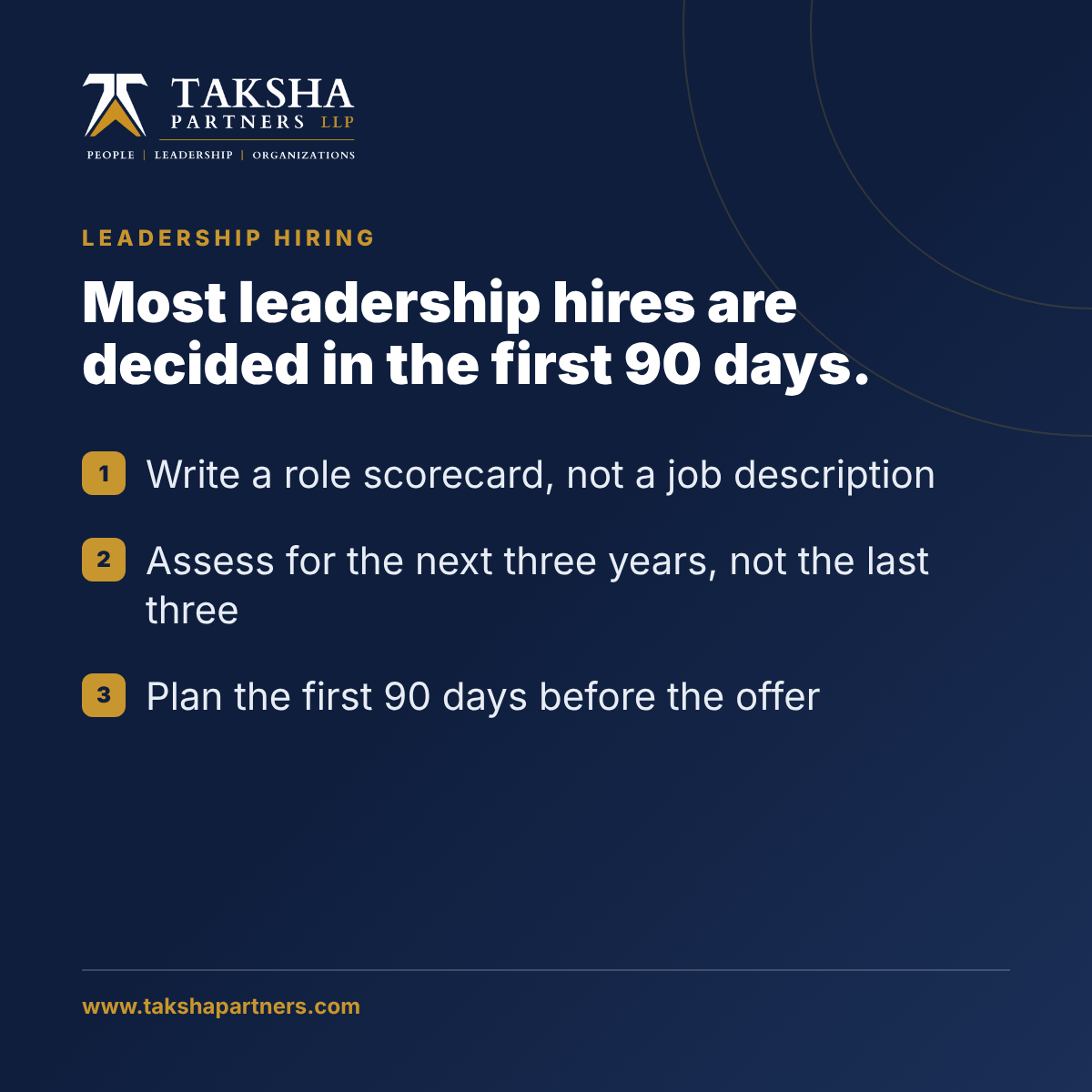
Hiring a senior leader is one of the most consequential decisions an organisation makes. The cost of getting it wrong goes far beyond the search fee: lost months, team disruption, stalled projects and, often, the departure of good people who worked for the wrong leader. Yet most leadership hires that fail do not fail at the interview. They fail in the first year, when expectations that were never written down meet the reality of the role.
1. Start with a role scorecard, not a job description
A job description lists duties. A scorecard defines success. Before the search begins, agree three to five outcomes the leader must deliver in the first 12 to 18 months — for example, stabilising plant output, rebuilding a sales team in two regions, or preparing the finance function for a funding round. Add the capabilities those outcomes require and the behaviours that fit your culture.
The scorecard does three jobs. It aligns the promoters or leadership team before candidates are seen. It gives every interviewer the same yardstick. And it becomes the basis of the new leader's first review.
2. Assess beyond the interview
Interviews reward confidence and storytelling. They are a weak predictor on their own. Strengthen the decision with:
- Structured interviews, where each interviewer covers different scorecard outcomes and scores against the same scale.
- A work sample or case discussion based on a real challenge in the role.
- Psychometric or behavioural assessment, used as a conversation starter rather than a verdict.
- Referencing against the scorecard — asking former colleagues about specific outcomes, not general impressions.
The aim is not to make the process longer. It is to make each step answer a specific question.
3. Write the 90-day plan before the offer
The first 90 days decide whether a leader gains trust or loses it. Before the offer is made, agree who the new leader will meet in the first two weeks, which decisions they should take early and which should wait, what support they will have, and how progress will be reviewed at 30, 60 and 90 days.
Sharing this plan with the final candidate is also a powerful signal. It shows that the organisation is serious, prepared and invested in their success.
The bottom line
A leadership hire is a business investment and deserves the same discipline as any major capital decision: clear outcomes, evidence-based selection and a structured start. Organisations that build these three checks into every senior hire see fewer early exits, faster impact and stronger leadership benches.