
Insights · 8 November 2026
Your HR policy manual since the Labour Codes took effect on 21 Nov 2025: a five-point review
Since the four Labour Codes took effect on 21 Nov 2025, a practical five-point review to bring your HR policy manual up to date.
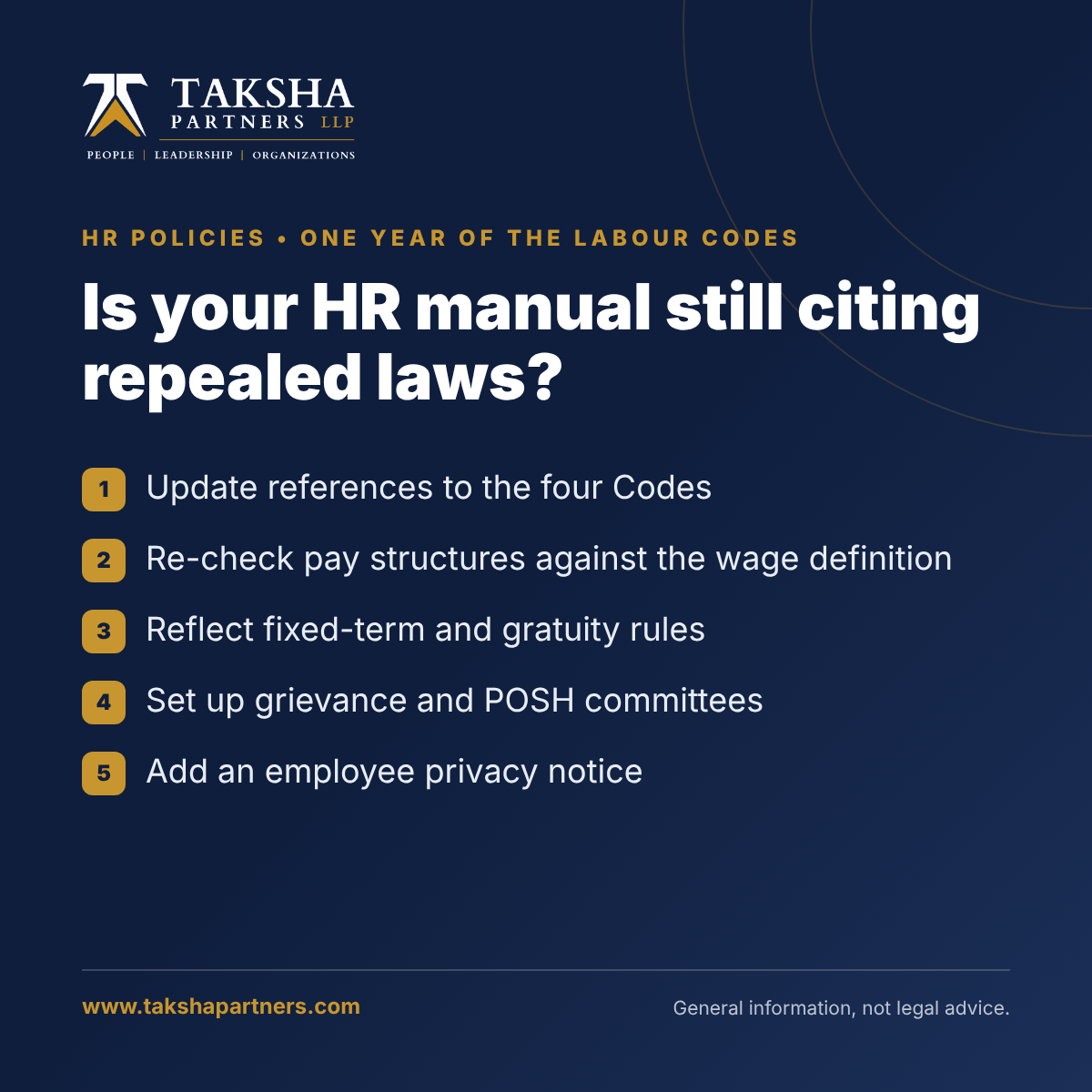
On 21 November 2025, India's four Labour Codes — on wages, social security, industrial relations, and occupational safety, health and working conditions — came into force, replacing 29 central labour laws. Nearly a year later, many organisations have updated payroll, but their HR policy manuals still cite laws that no longer exist. Outdated policies create confusion for managers, inconsistency for employees and avoidable risk for the organisation.
1. Update the legal references
Replace references to repealed Acts with the relevant Code and its rules. This is more than a find-and-replace exercise: definitions, thresholds and terminology have changed, so each policy should be read against the new framework and the applicable state rules.
2. Re-check pay structures and wage-linked benefits
The Codes introduce a common definition of wages, with limits on how much of total remuneration can sit in excluded allowances. Review how this affects benefits calculated on wages, such as provident fund contributions and gratuity, and make sure the policy language matches the payroll configuration.
3. Reflect fixed-term employment correctly
Fixed-term employees are entitled to the same working conditions and benefits as comparable permanent employees, and gratuity eligibility for fixed-term employees follows a shorter service period than for others. Contract templates, benefit policies and exit processes should reflect these terms.
4. Confirm grievance and workplace-conduct committees
- Grievance redressal committees are required in industrial establishments above the specified employee threshold.
- Standing orders apply above the specified threshold for industrial establishments.
- Under the POSH Act, an Internal Committee is required where an organisation has ten or more employees.
Check that each committee is constituted, trained, documented and visible to employees.
5. Add an HR privacy notice
Under the Digital Personal Data Protection Act, 2023, with full obligations applying from 13 May 2027, employers process a significant amount of personal data about candidates and employees. An HR privacy notice should explain what is collected, why, how long it is kept and how employees can raise questions — grounded in the appropriate lawful basis, which for employment purposes may include legitimate uses as well as consent.
Make policies usable
A good policy manual is current, short enough to be read and clear about who decides what. Each policy should have an owner and a review date, and managers should be briefed when key policies change.
General information, not legal advice. Applicability depends on the establishment, workforce and state rules; take advice from counsel where needed.